Friday, April 11, 2014

THE ACUPUNCTURIST A Taste of His Own Medicine

THE ACUPUNCTURIST
A Taste of His Own Medicine
     
"Go to hell; see if I care," said the director of the Taiwan Lung Association. How could Emerson have known that the Taiwanese doctor understood English? The doctor had heard Emerson say to his wife that he wanted a second opinion. This doctor wanted to cut his lung out. 
     "I am the head of the Taiwan Lung Association!" he said angrily pointing towards the door of his office. "If you need a second opinion, go, but don't come back. I'm not helping you anymore!"
     "With that attitude, I don't need your help," shouted back Emerson as he took his jacket briskly and headed out. "
     "Do you realize what you just did?" said his wife in the taxi on the way back to their home. "You just gave up the last chance for you to get well. Go ahead; die, see if I care." Emerson knew she really didn't care as much about his health as she did about his money and her own saving face.
"They can cut your lung out, sweetheart, but they aren't touching mine!" Mr. and Mrs. Davis didn't talk the rest of the way home. Occasionally Emerson hacked a cough, opened the taxi window, and spit out phlegm onto the street. 
     "You're disgusting!" his wife scowled, her long upper teeth glimmering in the oncoming headlights. 
     "But it's okay for the driver to open the door at every red light and spit bloody betel-nut juice on the street. That’s okay. Right?"
     "It's not blood; it's cinnamon they put in the nut." Being correct was most important to her under any circumstance.
     After they got home, Emerson took out a fold of paper with powder he had gotten from the dispensary of an ear, nose, and throat clinic; a doctor there with a reflector light on his forehead, twelve inch Q-Tips, and a row of humidifiers lined up in his clinic like hairdryers in beauty salons had prescribed it for him.
The virus he had caught from one of his adult English class students. Students didn't have the habit of covering their mouths when they coughed or sneezed in class. If they were on the street, they merely covered one nostril with a pointer finger and blew the snot out of the other. If there was a waste basket nearby, they blew it in there. Sometimes, they didn't have a waste basket; a handkerchief would do. Occasionally they would go to a W.C. and find a toilet or urinal to spit into. 
     One sleepless night, on his way back to bed from the bathroom, he spoke to his wife.
 "Let's go to that acupuncturist your sister was telling you about. Maybe he'll know what to do. My back is killing me."
“You mean Dr. Lam?”
“Yeah, that one.”
      Emerson had been coughing so violently the previous two weeks that he threw his back out. Maybe they'd have to cut his spine out, too, in addition to his lung and kidney. 
     "Maybe he can help you; he's not a Western doctor, though. You said you only trusted American-trained doctors"
     "I don't, ker-choo, care if he comes from the moon. Your sister said, (hack-hack-spit) he was good, right?" Emerson had heard convincing testimonials about acupuncture. In China, women had childbirth with no sedative other than acupuncture and experienced no pain.
     The next morning, they got in a taxi and went to the Chinese Herbal Clinic of Dr. Lam Chat-Hom; no appointment necessary. The clinic was a non-descript storefront on a busy Taipei two-way road, three or four cycles haphazardly parked on the sidewalk outside the clinic entrance, unlit with soot coating metal grate over glass, a weather-damaged hand-painted sign printed on yellowing plastic mold near plant pots that were watered by rainfall alone, exposed electric wiring on the pole near a side ally, a step down and two steps up unevenly walked under the building overhang. The clinic, the front rooms of his residence, entered down a harsh florescent hallway, a dozen mismatched chairs of different sizes and shapes along both sides. One stepped over the outstretched shoeless legs of a motley crew of elderly patients occupying. Emerson was the only foreigner. The air, smelling like vinegar with incense-smoke and medicinal plants thrown in; it was the smell of medicinal gao-liang liquor that shot up the nostrils.
     The doctor came out of one of three exam rooms wearing a white smock, grinned at the different Caucasian face of Emerson, walked past to a smudged gray-steel desk, bent low to say something to a dour middle-aged woman wearing an ancient nurse’s cape taken from a Hemingway novel and returned to the exam room. The nurse turned in her squeaky swivel-chair to a cluttered sliding glass-door cabinet, to a shelf holding curled papers wrapped in rubber-bands and removed a pumpkin-sized white ceramic bottle with darkened cracks. On it, an etching of a bald blue Chinese sage sat holding a peach in one hand and a long staff in the other. She removed the ceramic cap, poured some liquid into a little soda glass, stood and went over toward Emerson and his wife and spoke with her in Taiwanese.
     "Drink this. It is good for you," Mrs. Davis told her husband. The slightly bent nurse smiled, kowtowed, and went back behind her desk. Emerson drank up. His nose wasn't stuffed any more now that his virus had left his system but his back still ached whenever he bent over. He could smell the kaoliang liquor with some herbal additives thrown into the mix, clearly. 
      Dr. Lam had made a good point about the medicinal cocktail. It warmed Emerson to the point that he forgot he was sitting in a drafty waiting room of an herbal doctor's clinic. He had almost forgotten his bad back, too, that is until he tried to stand up to return the empty glass to the nurse. That's when it hit him; either this Dr. Lam was the real deal with the acupuncture needles or the rest of his life would be regulated to drinking tainted kaoliang and other alcoholic brews, not to mention a few Perkasets and oxymorphines. 
     On his way to the nurse’s desk, her telephone rang; the doctor would like Emerson to enter his examination room on the left. His wife stood up, thanked the nurse profusely, and helped Emerson the twenty or so steps down the pebbled cement-slab hall, wearing slimy artificial leather slippers, with forty-seven oriental eyes upon him; three elderly patients had one eye each to match their missing rotted feet.
     When Emerson seated himself on the aluminum bed cushioned with fitted-linen tatami pads, another full glass of medicinal kaoliang was placed in his hand by the nurse who told his wife standing nearby to wait a moment until the doctor would be with him, but to have Emerson take off his shirt and unbuckle his pants in the meantime. Patients, on their way to the restroom, passed Emerson's exam room and paused to stop, look in, and give the thumbs up to this foreign believer of Chinese voodoo.
     Dr. Lam entered, white doctors garb buttoned to the top, a white plastic Wyeth pen shield lining his upper left pocket. "How long have you been in pain?" he asked Emerson in halting but understandable English.
     "Over a month now," Emerson's wife answered in Taiwanese.
     "Really," Dr. Lam replied surprised, even though, from the look of his patients in the waiting room, a month of minor pain would have been an endurable interlude for their hunched backs of chronic backaches.  Emerson was lucky, and he knew it.
     "Cigarette?"
     "We can smoke in here?"
     "Sure"
     "Isn't it bad for you?"
     "As long as you live in Taipei you should not stop to smoke." He took out a yellow pack of Long Life cigarettes with the same picture of the large-headed sage with a peach and staff, just like on the jar of medicinal kaoliang. 
     "You mean I shouldn't stop smoking?"
     "No. You should continue," Dr. Lam said as he turned to an aluminum table to take hold of a deep jar filled with blue fluid. The acupuncture needles sat in the jar like combs used to sit in the jar of barber shops back in Brooklyn, to anesthetize the items before they swept through the next customers hair, only these antiseptic needles would soon be pierced through Emerson's skin, somewhere. 
     "There is lot of oxygen pollution in Taiwan air, no?" Dr. Lam explained add he took a drag on how cigarette and handed Emerson an ashtray to catch his falling ash.
     "It's very bad the air," Emerson blew out his smoke and tapped his cigarette ash into the tray. “The tar in the cigarette covers your lungs and prohibits pollution from attacking you."
     "You mean it acts as a shield coating my lungs?"
     "Exactly," said Dr. Lam, taking a swig of his one supply of medicinal kaoliang from a personal flask in his lower left pocket.
     "That's the first time I've heard that. I like that idea," said Emerson, a lifetime pack-a-day cigarette smoker. 
     "Show me where it hurts." Emerson pointed to his lower back. The doctor gave a look.
     By that point, Emerson's back pain was the last thing on Emerson's mind. He was feeling the effects of his third glass of kaoliang and enjoying his cigarette. His wife excused herself and returned to the waiting room to let the boys inside have their fun. She heard laughter and loud talking coming through the doorway. Dr. Feel-good was making Emerson feel good and he hadn't pricked one needle into him. 
     In the next fifteen minutes, twenty needles were twisted and snapped into Emerson's prostrated body: in his ear lobe, shoulder blades, neck, leg, and even the back where the pain originated. Then, the doctor rolled over a silver machine on wheels and flipped on a few switches. Next, he took twenty wire attachments from the side of the machine and, with alligator clips, clamped them to the open ends of the twenty acupuncture needles. Emerson felt no pain.
 Dr. Lam offered him another cigarette and held out a match so Emerson could light it from his reclining position, an ashtray placed on a chair to the right of his exam table.  Through the hole in the exam table Emerson put his head and down through it smoked his cigarette. Then it happened;
The machine was turned on. A trilling vibration shot through there needles into his body followed by pulsing ticks of electric stimulant. Trrrrrrril tick tick tick tick tick tick tick, trrrrrrrril tick tick tick tick tick tick…The doctor asked if Emerson could feel it under his skin. Emerson nodded into the hole in the table.
     "Stay here for thirty minutes. You will fewer better." He left a pack of cigarettes on the chair in front of Emerson and left the room, turning off the light for shade. 
     After thirty minutes, Dr. Lam returned, put on the light, removed the alligator clamps from the needles, and told Emerson to sit up on the exam table. Emerson did so with a back that felt better already. It was a miracle! The doctor offered him another glass of a kaoliang and a cigarette and told him to return the following week for another treatment.
     "You will need four treatments because your back is so stiff. You should come here directly next time you have pain. I help you good."
 Emerson followed his wife to the nurse’s desk as she paid. Another patient was called by the doctor into the exam room behind him.
It was 8:00pm by the time they got home. They'd been at the doctor's office seven hours but it was worth it. Emerson could actually dry himself after he showered. The pain was mostly gone. Only a ghost of it prevailed reminding him of where the pain had once been.
     A few weeks after his last treatment from Dr. Lam, Emerson and his wife went to eat at a restaurant a friend had suggested to them. It happened to be a few block from Dr. Lam’s Chinese Herbal Medicine Clinic. It was in a dark night club atmosphere with Taiwanese music playing on a CD jukebox. There was a smoky bar counter with a dozen liquor bottles lined up on a shelf over a frosted black gala mirror. The food was Hakka style. The tables had cloth covers with glass over them so the waitress wouldn’t have to keep changing them when they got soiled.
As they sat and looked over the menu, they heard the intermittent sound of a hard object hitting the counter followed by a tumble of beads. Each time it happened, there was a roar from the crowd of men who gathered around the sound at the bar.
“What is that noise?” Emerson asked craning his neck to look over at the disturbance.
“They’re drinking,” said his wife without taking her eyes off the menu. “We’re ready,” she called out to a waiter who came by with a pad and pen.
“But why are they making so much noise?” Emerson asked again, this time standing to get a better look.
“They’re playing a game,” she said slightly disturbed that her husband was more distracted by them than by her. “They’re playing a drinking game. Now would you pay more attention to what I’m saying?”
“One second, one second. I think I see someone I know over there.”
“You know someone here?”
“Yeah. That man in the white doctor’s jacket looks familiar.” Emerson stood up gingerly to as to not reinjure his bad back and walked slowly over to the bar. There was someone there who he recognized; he just wasn’t sure because that person seemed do out of place. It was clear now to him; Dr. Lam was sitting there on a stool, cigarette hanging from his lip, with a thick black plastic cup in one hand and a glass of whisky on the rocks in the other, surrounded by well-dressed businessmen who yelled with delight at him slamming the over-turned cup down onto the bar counter. He caught a glimpse of Emerson out of the corner of his blood-shot eyes.
“Hey Davis, how did you know I was here?” Dr. Lim called out as the others followed his eyes and looked over at the foreigner in their mitts.”
“You look like you’re having fun, doctor,” said Emerson ironically.
“I am, I am!” Dr. Lim said loudly through the din of the crowd and jukebox music. “Here, sit down,” he said as he stood up from his stool. “Come join us. Cigarette?”
“I’m here with my wife.”
“Oh!” He stood up to where Emerson was pointing and walked toward Mrs. Davis.”
“Davis tai-tai. Ni hao? Ni ze-ma jr-dao wo zai ji-lee?” That means, “Mrs. David. How are you? How did you know I was here?” Mrs. Davis didn’t know what to say. Dr. Lam wasn’t drunk but too happy.
“I’m going to have dinner now. Thanks for the invitation. Enjoy yourself,” Emerson said in a loud voice with a big smile, winking one eye, and sitting down gingerly to join his wife for dinner.
“Hao. See-you.”
As he walked back to the bar, Mrs. Davis seemed angry as Emerson shook his head in mock disbelief and took a sip of his sofa.
“You think that’s funny? Bu hao yi-se.” Embarrassing.
“Noooo. It’s crazy.”
They sat quietly and listened to the music, Emerson happy but pretending to be disturbed so his wife wouldn’t be upset by him again. He got up gingerly, holding the back of the seat for support, and went to the restroom. On his way back he noticed a smell of smoke; not cigarette smoke, but smoke from a fire.
“Do you smell something?” he said as he slowly sat down in his chair.
     “Smell something?” his wife repeated.
“Yes, I smell smoke. Don’t you?” said Emerson as he glanced around the club for the source of the odor.
“It’s prayer money. They’re burning prayer money outside for the holiday.” Emerson knew that the Taiwanese were always throwing drab slips of construction paper they referred to as ‘money’ into round metallic containers.
“No. It’s not that smell. I know what that smell smells like; it’s not that burning smell,” said Emerson now more alarmed and getting no sympathy from his wife.
He glanced around the club again and toward the windows on each side of the corner entrance door. He thought he might see someone lighting something outside. Then, he caught a glace of what it was; he looked up from the windows bottom to the top where a store awning outside had flames billowing from it dropping melted plastic sparks onto the sidewalk below.
“Call the fire department! There’s a fire outside!”
“What?”
“There’s a fire outside! Someone call the fire department!”
 Mrs. Davis turned in her chair and saw what Emerson had seen. She stood up immediately, went to the entrance, and stormed outside to the street. There she stood for a good minute or two transfixed as the awning fire exploded raining molten plastic onto the street below.
 She stormed back inside and told the cashier who was oblivious to anything until she alarmed her. Dr. Lim and his businessmen friends remained as they were before, playing games, drinking, and smoking at the bar counter. One man, perhaps two, turned around to see what the commotion was at the front of the club. No one moved out of their seats or left the club except for Emerson whose wife stood him up and took him outside.
     Five minutes later, those outside of the club could hear the quiet fire alarms on the tiny red trucks coming up the street. Dr. Lam remainedinside and had a taste of his own medicine.

Wednesday, February 26, 2014

Return of the Ami Native

 Return of the Ami Native


     “But when did he start drinking?”
     “All his people drink.”
     “Why?”
     “I don’t know.”
     The conversation wasn’t going anywhere. All I knew was that we were going on vacation to a scenic spot on Taiwan’s southeast coast. Since her classmate from junior college lived there, we were going to visit him and his girlfriend; they had invited us. I was told he was an Indian.
     “From India?”
     “Are the Indians in America from India?”
     “No. Actually, they’re from Asia.”
     “What?”
     “They walked across a bridge from Asia to America.”
     “Well, my friend’s people came to Taiwan by boat.”
     “Are you sure? There was a land bridge from China to Taiwan-”
     “My friend doesn’t come from China. He speaks Ami. He’s indigenous. His indigenous language is Ami. His people came to Taiwan thousands of years ago, probably from Malaya; their languages have the same root. He is Polynesian, like the Hawaiians.”
     This was becoming interesting. If I wanted to meet a real Indian, I would have taken a vacation in India, but a Polynesian in Taiwan?
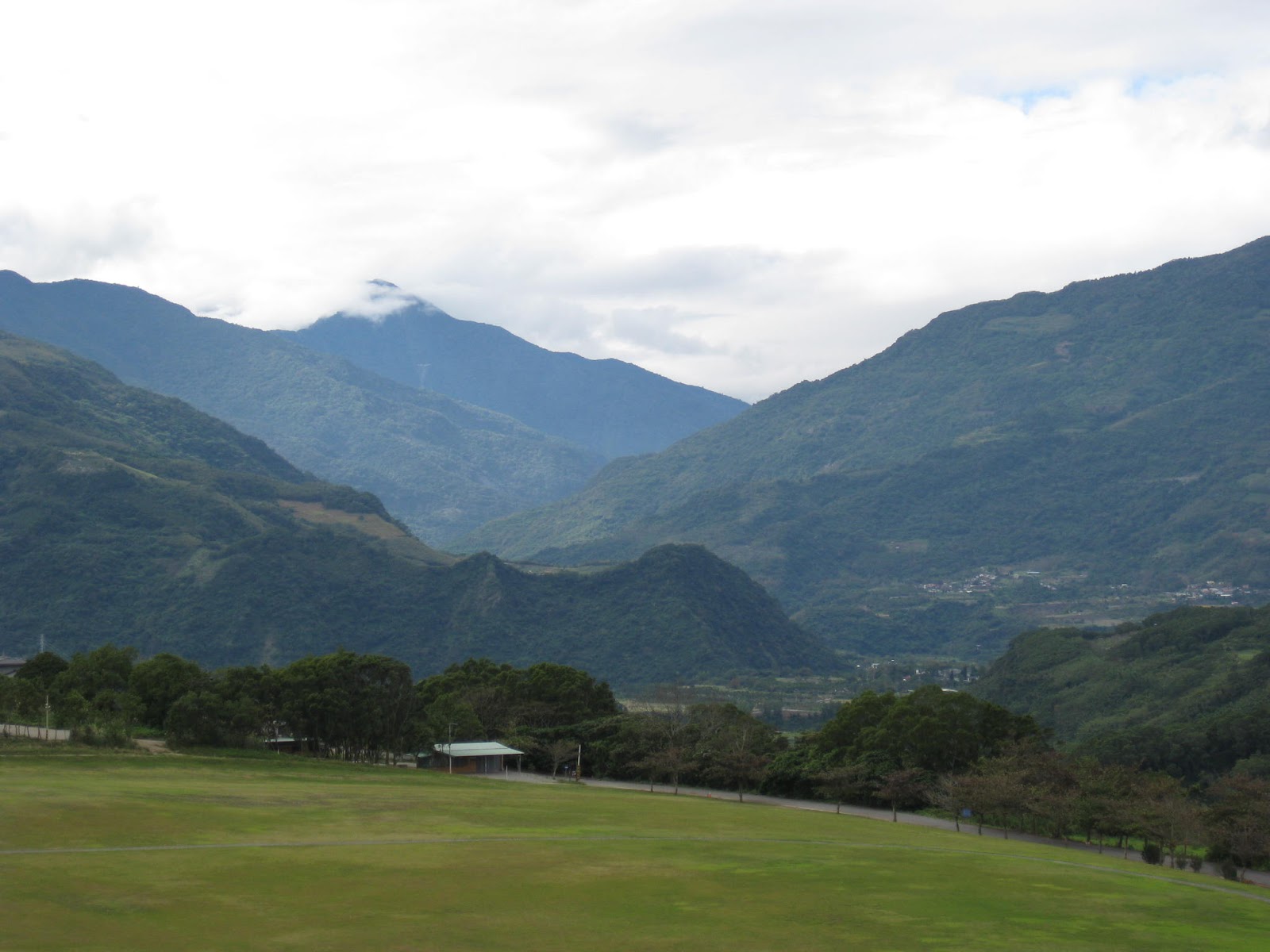
The train chugged along close to the coastline, nestled between the Pacific Ocean and the tall, lush, Taiwan mountain range heaved upward the last time the tectonic plates shifted violently. The train, heading north, passed through dozens of shed-like tunnels; covered bridges to keep the rock slides from destroying the track bed every typhoon season. The Taiwan Railroad hasn’t been electrified, yet, from Kaohsiung down and around the bottom of Taiwan and up the east side of the central island mountains. The diesel picked up speed, its heavy engines roaring for ten minutes or so until the engineer decided it was fast enough to coast a while until a low speed required a boost again. Then the engine was fired up, like a kid who pushes a skateboard down the street a little, and glides.   
“Here comes that lady with the Phillip Morris pillbox hat.”
“Stop making fun of her; that’s her uniform. Give me your bottle.”
“It’s empty.”
“That’s why I want it; she’s collecting trash.”
“I thought she was selling lunch boxes and souvenirs-”
“Just give me your empty bottle.”
The porter took the bottle and placed it into a narrow wheeled receptacle that she pushed up the aisle and into the next train car.
There was an announcement over the train’s PA in three languages. “Luye, next stop,” she said. It had taken over three hours to travel 117 miles from Zuoying to Luye when the 140 miles from Taichung to Zuoying took forty-five minutes by high speed rail!
“Only a few trains come here every day. It’s so inconvenient.”

“But the mountains and ocean are so beautiful for tourists.”
“Not when there’s a typhoon and the transportation is cut off.”
“So why did your friend return after he had escaped to Taipei?”
The diesel revved its engine and pushed up one more incline between the mountains before sliding into a tiny grade-level one track station. There were no railroad crossings; one side of the station was a little street with store fronts and the other side was a ravine that sloped into another lush mountain.
It had been twenty-five years that my wife was friends with this brown-skinned classmate. He was one of the few aboriginal students on campus, matriculation made possible by the affirmative action of points added onto his entrance exam; that qualified him, barely. He was in printing classes with her. Too often, he chose instead to skip out to drink and gamble with the boys. He didn’t make it to graduation day. One day he just stopped going to classes and disappeared altogether.
“His name was Tang Tzu-Jiang.”
“That doesn’t sound like an indigenous name to me.”
“It isn’t. ‘Mountain-land people’ was what we were taught to call them; they were given Chinese names by the government. They weren’t allowed to use their native names officially then.”
Her friends had kept in touch with him for a while after he left college. He eventually drifted down to Taichung and tried to make it as a musician. He played the bass in a rock ‘n’ roll band. He did everything to assimilate to the mainstream culture of modern Taiwan, but something held him back; there was something in the way on his road to fame and sameness. Perhaps the alcohol would open Pandora’s Box, or maybe he found being locked inside of it a safer place to exist. The change in him seemed small and innocent, but it turned out to have severe and far-reaching consequences.
There, on the street up the hill from the train station to the main road, was a beef-noodle shop owned by the family of Tang Tzu-Jiang’s girlfriend. She’d been his childhood friend. She had heard, through his family, what he’d been going through in the big city up north. She went to rescue him from the desolation that alcoholism brought him and took him back to their hometown, Luye. She welcomed us when we arrived and let us leave our bags in the restaurant until her boyfriend arrived; he had overslept. There was late party the night before and he was sleeping it off.
“Is he still drinking?”
“Not really. It was a friend’s party. He had to go and drink.”
Before too long, Tang Tzu-Jiang arrived on his scooter. His high nose and round brown eyes weren't oriental. His diminutive body, hunched and punchy, seemed to straighten a bit as the smile spread across his face in seeing his old classmate. He ran his hand through his smoky black disheveled hair and they hugged. She introduced me to him and we shook hands.
“Where are you going to stay?”
“We’re taking a room in the Deer Community Lu-Tai ‘Homestay’.”
“That’s the one on the mountaintop where they have those hot-air balloon rides in the summer?”
“It’s good, right?”
“It’s crazy there in the summer.”
“We heard. That’s why we came here now. We couldn’t get a room there in the summer.”
“Yeah, impossible. We’ll drive you up there later. For now, let’s eat. You must be hungry. Honey, get my friends a beer.”
“That’s okay. We don’t drink so early in the day.”
“You don’t mind if I drink, do you?”
“No, go ahead,” I said. “Hey, let me see your fingers.”
“What?”
“Your fingers. No, on your right hand.”
“What up with your husband?”
“I told him you were a bass player.”
“Oh, tell him I haven’t played in over two years.”
My wife translated for me. When a musician stops playing music, that is serious. All you have left is your music. When that’s gone, what else is there? But Tang Tzu-Jiang wasn’t the first Ami to have the music stolen from his life:
Each day of the 1996 Atlanta Olympics, with millions of people around the world watching on television, “Return to Innocence,” an Ami chant was played; listen to it on You Tube. It was only after a friend in Taiwan recognized their voices on the radio that 76-year-old Kuo Ying-Nan and his wife Kuo Hsiu-Chu, learned of a new version of their song, “Palang.” In Ami tradition, it is performed by a host to welcome guests. They had received neither credit nor payment for being the star singers. The case was finally settled out of court.
"Come. Let's go take a ride."
"Where are we going?"
     "Up that mountain." She pointed to a slight incline on the other side of the main two-way road. "My friend's girlfriend knows a man with a scooter rental service near the station. He'll let us rent one for free."
     "But I don't have a motorcycle license."
     "That's okay; you don't need a license to ride an electric scooter."
     "Okay then, let's go."
     The two of us put on helmets and rode a quarter mile up the main road until a fork appeared to the right. She pointed up the incline. She made it up on her gas scooter just fine but my scooter barely had enough power to get to the summit. 
     The top of the mountain leveled off onto a two-square-mile plain before the mountain jutted up again to the next altitude. Here, in the bright sunshine of a cool winter day, there were endless rows of bushes; tea bushes as far as the eye could see, to the left and up ahead of us. To the right, we saw what appeared to be a lawn, a lawn bigger than two baseball fields and just as wide, As we approached on our scooters, the lawn took on another dimension; it wasn’t grass; it was a lawn of spiky leaves, almost like miniature coconut trees. It was an endless field of pineapples that we saw. Thousands and thousands of greenish yellow pineapples of all sizes, cute little pineapples the size of an apple and enormous pineapples the size of a football. Butterflies and bugs flew around and landed on the trees on the perimeter of the rectangular field. It was the first time I had even seen a pineapple that wasn't in the produce section of a greengrocer. I had thought they grew on trees, like coconuts. I always wondered how many people were killed every year by falling pineapples.
     On the other left side of the field, across a dirt work road, some other flora stood up against the background of lush green mountains and crisp clean east-coast air; Lines and lines of trees, about as high as a lamppost. Each tree was laden with what looked like large pink fruit hanging from the branches, perhaps two dozen per tree, and there must have been a hundred trees.
     "Shik-ya."
     "Shik-ya? What's that?"
     "Apple-custard fruit they call it in the west. Here they call it Buddha Head fruit."
     "Have I ever eaten one?"
     "Those are the fruit with slimy white meat inside on big black pits; they were selling them outside the train station.”
     "Oh, those! Wow! But these are pink. The one's I’ve had are dark green outside and feel like a leatherback turtle."
     "Silly, those are pink bags around the fruit to keep the insects and birds from eating them."
     I was tempted to eat one and started to walk over to a tree to pull off one from the branch for a snack, but my wife stopped me. She scolded me for wanting to steal private property; how would I feel if everyone who stopped by picked one of my fruit? I felt ashamed. I recalled the talking apple trees in “The Wizard of Oz” when Dorothy plucked one of their fruit. "I guess you're right, but they look delicious."
     "We'll ask my friend if we can have a few when we get back to the store."
     ""He doesn't have to do that. We can buy some when we go home."
     "I'm sure he won't mind parting with a few; this is their harvest season, anyway."
     "Wait a second. What do you mean, ‘their harvest season’?"
     "Oh, I forgot to tell you: these are his fields; the fruit belong to him."
     "All of it?"
     "These lands are from his ancestors. They've lain barren for years but since he came back home, he's begun to work the fields; his old friends have been showing him how to farm them."
     It boggled my mind that this man would have ever wanted to leave such a beautiful place for the pollution and bustle of Taipei; that he would willingly give up fertile lands left to him by his family in exchange for the second-hand life of the city.
Being a city boy myself, I longed for the land spreading out so far and wide. I envied the people who farmed the land and lived upon it. It wasn't until I was in my thirties that I learned about the sinister purpose of agribusiness and Monsanto terminator seeds. I could sit and stare for minutes at strange red flying insects that landed on my laptop. Why would anyone want to squish one? All the way around the fields on our scooters, I breathed in the sweet smell of real air, without motor additives, a fragrance I had almost forgotten living in the smoke drenched air of Taichung. This land didn't remember me. I didn't know what beauty it revealed. I realized the land was not forgotten by me; I was the one forgotten by the land. I was one of the forgotten people of Taiwan, too. 
     "Why are there so many birds in the field on your friend's side of the road but there are no birds on the other side."
     "Yes, that is strange. We'll ask my friend when we get back. Hey, we better get going; the sun is starting to go down. We really should go check in to our bed and breakfast."
     When we got back to the beef and noodle store, the corrugated door was rolled down halfway as her friend's girlfriend put away the last dishes and pots from the afternoon business. They'd open again for dinner hours but she had time now to drive us to our lodgings. On the wooden table outside the restaurant sat three cans of Taiwan beer. She picked them up and put them into a recycling bin. A few minutes later, her boyfriend, with a fresh can of beer in one hand, came out of the restaurant with a large paper box in his other hand and placed it on the table in front of us. Inside sat six gorgeous plump shik-ya, just for us. 
     "Thank you so much, so much."
     "Ask him about the birds in the fields." 
     My wife asked, he answered, and she translated. "He said the birds stay on his fields because he doesn't use pesticides like the other farmers. The birds wouldn't dare eat the insects on the other fields."
     "But isn't he afraid he'll lose money if his fruit are damaged."
     "His family is teaching him how to do organic farming. There is a way to keep the bugs away. The fruit may not be so beautiful but they are sweeter and safer to eat. Come on. They're going to drive us up."
On a winding one-lane road, the old sedan careened over broken pavement and around hair-pin turns, riding center to the double line without a care of on-coming traffic. Up the mountainside we went, Tang Tzu-Jiang with beer can glued to one hand, a cigarette in the other, twisting in his seat to chat with my wife sitting next to me in the back. I kept my eyes on the road as if I could do something about warning his girlfriend about a reckless pick-up truck she might not see coming around the bend; she hadn't a care in the world behind the wheel.
     We reached a cut-off with an artistic bilingual sign by the side of the road put up recently. Here was the bed and breakfast private road. The road went on with pineapple groves on either side and then veered to the right as the return road veered off to the left; the lodgings were somewhere in between where the roads met. Then,  sighted between shrouds of clouds on mountain tops of surrounding peaks, like a mini-Portola, sat the modern Swedish-style villa, all in cement and marble, up a driveway of ill-conceived slippery marble chips. In front of the grand entrance of heavy sliding doors we said goodbye to my wife's friends until the next day when they would pick us up to have lunch before we had to return to Taichung.
     Marble floors everywhere, like a status symbol, in the bathroom and in the lobby which also served as a dining area and bar, enclosed in wrap-around picture windows looking out onto the slope down a grassy field, the field where, in springtime, entrepreneurs moor their hot-air balloons teetered to ropes tied to anchors and take visitors straight up in the basket about ten-stories high, then bring them town again, for an astronomical price. Up and down they go in slow motion like wax globules from a lava lamp, but not in the winter in Taiwan; the winds whipping around the mountains would give the poor explorers the ride of their lives, not that it would be illegal but the proprietors could lose their precious investments somewhere over the rainbow. So in the cold drapeless marble villa we stayed, sheltered from the wind, and into an empty gift showroom we ventured to see the overpriced hand-picked faux-upgrade exclusive products from their winery on organic shelves as a few other visiting families wandered lost pretending they were happy they came, probably wondering who would be rich enough to sleep over in the five room lodgings upstairs. It was us they were wondering about; a foreigner with his Taiwanese woman, wife perhaps. 
     It was getting colder as the sun started going down but we had to make the requisite walk around the grounds before we hunkered down for the night with nothing put a prix fix dinner menu and flat-screen TV at the foot of our bed. With nothing left to see that war hadn't seen on the ride up, we turned our collars to the wind and headed back up the slope to the fancy-schmancy villa. We were one of only two parties having dinner in the dining area that night and I knew why; this was the wrong time to come to a cold place with no ambiance. Our hearts were the only parts in the tomb beating blood. Even the maitre de maison was surprised but glad to see us; they hadn't bothered to install heaters or fireplaces in the villa figuring no one would come to be warmed by them. No one was going to be warmed by anything that evening; we sat enjoying nothing but each other's company at the dining table. Then my wife's cell phone rang.
     "Tang Tzu-Jiang wants to know if we would like to join them at a karaoke place they know nearby."
                                  "Yes. Tell them yes!" 
     "They'll come pick us up in half an hour."
     We didn't have to go up to our rooms to get our jackets; we were already wearing them for dinner. Before you could say "hootenanny," Tang Tzu-Jiang and his girlfriend returned looking exactly as they did when we'd seen them last, a beer can still glued to one of his hands and a cigarette to the other. Down the road we went as fast as she could, driving the wrong way around the air-balloon field ("because it was closer that way") and down the mountain road, still hugging the center line on the road, only this time the headlights were on. We weren't headed for Las Vegas, that was for sure, and the nearest city, Taitung, was an hour away. 
     Before we could figure out where we were going, the car slowed down, seemingly in the middle of nowhere, and pulled into an uneven gravel driveway etched out between two barbed-wire fences and some broken tree limbs. There were no house lights or lit signs, maybe no signs at all. The black Taiwan dog that came to greet us in the lot was wagging its tail even as it limped toward us on three good legs, the forth dangling at its side. It recognized the car and didn't bark. 
     There was something else forgotten. The silhouette in the dark outdoors hushed voices stoking memories with long branches. Holding the spoken in the hub of the wheel, dancing ambers like stars in the sky of a cloudy dream shooting up and becoming vapor trails of smoky comets in the heavens above.
     The music of a rowdy Albuquerque square dance yipping and hollering there over yonder in a shipping container ball room with saw dust and hardened soil from too many spills of beer in the same place, absorbed into the natural carpet. The karaoke playing Taiwanese lovelorn songs of missed opportunities drifting, drifting with the tide and out to a sea where debris breeds barnacles and sailors long for dry land.
     The women pelted with whisky on a Friday night feel no remorse because this is where they came to be. No one can chase them away. So they sing and they dance while the men folk catch their eyes and grab at a phantom that has already left their body and joined God in hallelujah.
God drinks liquor, too, hallelujah, and rips into those too wholesome to enjoy their flash of existence on earth. God spits them out here and leaves these people the only peace they’ve ever known; with the brethren, they the heathens the Christian missionaries took into consideration. “Stop, you headhunting cannibals, and join us in prayer! So, the indigenous dropped their wooden Guan-Yin and Matsu statues into the fire and felt holy knowing the authorities would leave them alone, once and for all. “Yeah, I’ll believe in your Jesus. Now, fuck off, you American bastards!” Nothing like a Chinese Christian, for Christ’s sake!
  
The Ami’s music is primarily vocal singing. The adult songs tend to be impromptu regardless the melody, or lyrics. The songs relate to farming, weaving, fishing, hunting, parties, and dancing in real life. The Amis sing to please the holy spirits in the ritual ceremony; or to entertain other people at the party; or to entertain themselves while working. All the songs are sung by the leading singer at the beginning, and then followed by a group chord. For the group singing, they sing with the same melody, but each singer tries his/her best to sing with impromptu changes. The different tones from variable range create colorful and rich polyphonic sound effects. This singing style has been regarded as the most representative characteristic of the Amis music. However, this can only be seen in the Amis in Taitung.
     Outside, around the bonfire, I sat with my wife on tree stumps with
Tang Tzu-Jiang. His girlfriend and friends, all drunken and dazed or wandering in the darkness beyond the aura of flames, never lost, never saddened, and never bothered so long as they didn’t try anything stupid like getting a good job or being respected.
     “She wants to know if you’ll go back to her place with her; she likes you.”
     “Tell her I like her, too, but I’m too tired.”
     “She’s very drunk.”
     “I know. You wouldn’t mind if I slept with her?”
     “No, go right ahead.”
     The woman grabbed my hand and lifted me off the tree stub. The others laughed and commented as she dragged me into the shipping container ballroom and showed me to her friends.
     “You like dance?”
     “What dance?”
     “Any song; here.” She handed me a three-ring binder with clear pages filled with song titles on light pink and green pages. There was actually a section of English karaoke songs. I picked “Hotel California” and wailed away. I drank the wine bottled and filled with deadly bees to the brim; it had taken its effect on me. I sang just like Don Henley doing a Joe Cocker impersonation. My audience sat transfixed at this wild foreigner in their midst; the first white boy who ever dared to venture to this side of their tracks, and sing, this drunken white boy can sing for sure, though nobody knows what the hell he’s saying, and he’s not even sure what the warm smell of colitis rising up through the air smells like, though he’d like to find out. Yeah, I’ll go have sex with the drunken Ami woman, any time.
     “You sing a song. Now let me hear you all sing an Ami song.”
     “Okay.” And she spoke with her lady friends as the men looked on bewildered by my presence, and got into a toga line with me in the center. And we danced, lordy lordy; we danced as they lifted their legs and twisted left to right in unison. I lifted mine. They swung their arms around each other and I swung my arms, arm in arm, part of one organism with them. I was dancing a song that knew no history or sheet music, a song that no one could steal because it belonged to anyone who sang it. 
     Exhausted, I swaggered back across the yard to my stump at the bonfire. One of the women, one I was told was the chef at the establishment, wanted to show me something. She stood up and reached out her hand to guide me. There was something in the hut alongside the shipping container ballroom that I might want to see. Who was I to argue?
     Inside the dark storage area, with only the light from the bulb outside the water closet, the short middle-aged Ami proprietor with scraggly short black hair brought me to a back wall. She pointed down as if to say "Watch your step" and took a flashlight from a peeling, beaten wood table. She shined the light on the wall where a dozen organic objects hung by wrought iron hooks. She told me they were a collection of farming and 
fishing equipment from the days of old that she had held on to. When I looked confused about the purpose of a rattan scoop or leather strap held together by rusted chains, she demonstrated, as best she could, until I showed I somehow understood. Satisfied that she'd made her point, she put the light on the next object in her makeshift museum. Without a word of English and little Ami or Mandarin comprehension, I felt what it meant to her to be a native in this occupied island. If words could cry, she was making a river.
      "What did she want to show you?" my wife asked as I again returned to the fireside. 
     "Farm implements, you know, like that guy had in Doylestown, Pennsylvania, what’s his name, Mercer; he collected obsolete American farming tools around Bucks County. This woman had a nice collection."
     My tour guide returned with some slices of guava and passed it around, sat down and said something to my wife. She wanted to know if I was hungry. She wanted to prepare something for us. As she spoke, an older man with grizzled face and missing teeth leaned forward and, with his bare hand, lifted an object out from under the bonfire. He passed it from hand to weather-beaten hand like a hot potato, which, it turns out, is exactly what it was: a baked red yam wrapped in aluminum foil. He said that he had almost forgotten it and indeed he had; half the skin was burned off and the meat inside blackened. Nevertheless, he split it open and offered me the tenderest part.
     "It's not exactly a French restaurant," I said, "but it's delicious."
     "What do you expect; escargot?"
     "Yeah, why not," I joked and sipped the beer with my pinky up mockingly."
    My wife shared the joke with all present to see how this silly American thought. Suddenly, the woman who brought me in to see her collection stood up excitedly pointing her finger like Erwin Cory with an idea.
     "What's going on?" I asked
     "She's going to fix you some escargot."
     "What?"
     "I told her you liked escargot and she said she had a bowl of snails in her refrigerator. She's going to make them for you."
     "Are you kidding?" No, she wasn't. My wife translated. He friend told her he had collected snails that were walking around the pineapple groves and the grounds around their place. They always eat snails. They keep them alive in the refrigerator for a few weeks because you shouldn't eat dead snails. 
     Ten minutes later, our host returned with a steaming plate of escargot in a brown sauce with scallions and garlic. She handed me the bowl first with a toothpick and I stabbed one. Delicious! I hooked another, and another until my wife told me to pass it over. 
     "Do you know how much money this would cost in a French restaurant in Quebec City?" In fact six little snails in butter sauce would put me back $80 Canadian dollars. Here was a bowl of medium-sized escargot that would be a meal in itself. They weren't excited about my comparison; they were just happy I enjoyed eating her home cooking. I was stunned by it with delight!
     When a tall slim young man wandered onto the lot and wobbled left and right toward the fire, I knew the evening was taking its toll. The drunken gentleman, on the verge of stepping on hot coals, wanted to hug me and be my friend. I stood to take his awkward embrace. His drooling smile and reddened mouth was no match for his sincerity.
      "I like your friend," I told Tang Tzu-Jiang. He feigned a choke and expelled the mouthful of beer he had into the fire. Everyone laughed.
     "He said that guy isn't his friend; just a customer that had too much to drink” translated my wife. “Let's go; it's getting late and my friend’s ready to drive us back up the mountain. Okay?"
     Somehow - I don't remember at all - we said goodbye to everyone and got back into the car and rode into bed; at least that was all I remembered. I know it was a bed because it was soft, but it was colder inside the room than it had been out at the bonfire. 
     By 10am the next morning, we were back at the train station; the hotel had a driver bring us down. My wife's friend was nowhere to be seen but there was his girlfriend, cutting peppers, slicing onions, and preparing for another day at the beef and noodle shop. 
     "He almost died last year. One night after drinking heavily, he didn't feel well. He looked funny so I brought him down to the hospital. He was having a heart attack. He was suffering from alcohol poisoning and high blood pressure. We almost lost him. It was very dangerous for a few days. But then he pulled through. The doctor gave him pills and warned him, 'Next time might be your last time.' Since then, he has had less to drink. He's trying. We are all helping him. His family is teaching him how to do organic farming. That's where he is now; working in the fields. He's trying." If not for the love of this woman and family, this story would have a sad ending. 
The most important traditional ceremony is the Harvest Festival. The Ami Harvest Festival is to show the people's thanks and appreciations to the gods and to pray for harvest in the next coming year. It takes place every July to September. Come back then.”
My wife's friend is learning who he really is without the pressure of making it in the modern world. He comes from a place I've never been. I’ve had to start from scratch. The intruders of Taiwan have long forgotten who they are. Tang Tzu-Jiang has to pick up where he left off. His real Ami name is Tavarong. Don't forget to remember it.